|
||||
A legendary white gospel pioneer of
the '50s, FERN JONES, is remembered. Mike Rimmer spoke to Fern's daughter Anita Garner.
|
||||



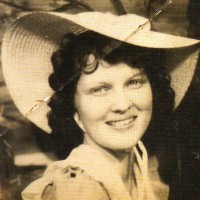 |
Fern Jones in the 1950s |
When she stepped into the studio in 1959 to record for Dot Records, she already had 25 years of singing experience under her belt and at the age of 36 was a veteran of the southern revival circuit where she and her husband Ray Jones and their family travelled around and held revival meetings. Sometimes they would take time out and pastor a church but music was always at the heart of their ministry.
In 1959, religion and the newly emerging rock'n'roll weren't as far apart as a lot of white preachers were intimating in their pulpit dismissals of the new music. Pioneers like Elvis Presley, Jerry Lee Lewis and Little Richard brought huge church influences into their music and while Jones stayed on the other side of the musical fence, staying true to the message. Her early music had been non-religious and had been performed in the honkytonks before she gave it up to sing with her husband and support his calling to ministry. Listening to her album, you could say that you could take the girl out of the honkytonk but you couldn't take the honkytonk out of the girl and something of that wild side remained in her gospel music.
My interest in her music began with the re-release of 'Singing A Happy Song' in 2005. The album, now renamed 'The Glory Road', had a CD release and included some bonus cuts from Fern and Ray's custom recordings made in the early '50s. Sadly, Fern didn't live to see the release, even though she'd been fighting since 1968 to buy back the masters from the record label. She passed away in 1996 but the work to have the album re-released was continued by her daughter Anita Garner. After I wrote the review of 'The Glory Road' for the Cross Rhythms website, Garner contacted me and I had the opportunity to quiz her about her mother, her childhood on the road at the revivals and some of the extraordinary events of her mother's life.
Effectively Anita was born into the family "business" of travelling evangelists. She remembers, "In the Deep South, we covered medium-sized cities to rural areas, travelling the same circuit as say a Billy Graham or an Oral Roberts. But they went on to become sort of 'mega evangelists' and daddy was much more comfortable with the country. He was a country boy. He worked to become ordained in the Assemblies Of God and later so did mother. So for about half our time we were in the evangelistic field. The other half the time the church would ask my father to pioneer a church in a town where there wasn't one. That was quite a particular set of skills. So we did both."
Coming from an extremely poor family, Fern Jones first started singing at the age of 12. Garner explains, "She was tall, quite matured physically and very, very poor. I've spoken to a lot a of people about how one person emerges without any money or any hope of success and sort of dazzles. I think she just had such a faith or such a drive to get out of extreme poverty. So she lied about her age. She got a Sears Roebuck guitar from a catalogue, learned a few chords, had an enormous voice and looked mature. Every one in the South just turned their heads and pretended she was old enough to be in the those joints."
She married at the age of 16 and very shortly afterwards became a Christian. Garner tells the story, "Daddy went down to the altar and turned his life over to the Lord. The story that they tell is that he went home, got her - she'd never attended church - took her by the hand and prayed with her all night." Ray Jones began pastoring a small church in Arkansas while working a day job to pay the maintenance bills on the church. People would come to the little church, hear Fern sing and almost immediately the invitations began to pour in so she started her singing evangelistic ministry.
I observe that this was a big calling for a young woman barely saved. Garner shares, "I think there was a lot of conflict with her attempting to grow into a woman. She was a mother at 16 and then I was born when she was 18. I think daddy in a sense was helping raise her. He was nine years older. He was the eldest of 10 and he was crazy in love with her. So she had these mature gifts, but she was still a teenager."
Anita Garner's own upbringing involved a great deal of travelling and she had to try and fit into plenty of new schools along the way. Her
parents also had their own radio shows whenever they settled somewhere. Anita soon joined the
family act and at age three she made her debut on a radio station in
The radio exposure and their custom albums helped to bring Fern Jones' music to the masses. There is one song on her album that also worked to bring her music to the masses. "I Was There When It Happened" is credited as a co-write with Jimmie Davis who added himself to the credits in exchange for publishing the song and attempting to make it popular. Anita tells of her mother's struggle with this. "This is a dilemma mother wondered about until she passed; would it be better to have 100 percent of nothing and have no-one ever hear your song? Or to sell half of it and have a famous gospel star record it? And she'll never know the answer. But she regretted forever that she sold half the song. And later, she was talking with both Rick Nelson and Elvis about recording her music. Each of them had chosen a song. Both of them insisted on half composer rights or they wouldn't record it and she did say no."
"I Was There When It Happened" became one of the favourite songs of the young Johnny Cash. If you've seen the movie Walk The Line then you'll have heard the song! Garner explains, "John told me this story himself in the 1960s. And then I've recently spoken to one of the original members of his backing group The Tennessee Two, Marshall Grant, who confirms that Johnny really planned to record only gospel. The movie depicts him showing up for an audition at Sun Records, being told to sing something, anything other than gospel and immediately being signed. Marshall says that when they went to sing for Sun Records they only knew "I Was There When It Happened". They'd been performing it at a few little places - churches, high school dances. So John said, 'Well, I want to be a gospel artist so we'll sing that one." And Sam Phillips really sent them home for a few days to write another song. But John told me that he sang "I Was There When It Happened" as a personal testimony in every performance that he could."
Listening to 'The Glory Road', the one thing that immediately strikes the listener is that unlike many anodyne white gospel albums of the time, this one is very bluesy. It sounds wild. Garner agrees, "It was. It was so wild. She was following her own instincts with those recording sessions for that Dot album. It was so wild that it almost killed her for airplay. She'd been a favourite performing live on radio in six States. They couldn't play many of the cuts from this album on white stations because she sings so black. And this was during the time of segregation in the South that we came up with her singing like that. She would have fit on race stations much better but she was too white for them!"
And that's where the problem lay. The album fell between two stools and despite the fact she'd turned in a great album, the lack of airplay stymied its success. Garner observes, "She turned out this amazing album with some of the most famous studio players; the ones who toured with Elvis. To this day no-one knows how she pulled all that off. And I don't think she knew she was a pioneer. I never heard her say any words to the effect that she was breaking new ground. I think she's one of those innovators that you read about and hear about who simply heard a new way to do something and didn't know she couldn't."
The album was made in Nashville and featured some amazing musicians who had just been recording sessions with Elvis Presley before backing Fern. Garner shares, "I speak now and again to Hal Bradley, who's the president of Nashville Musicians Union. Hal and his brother Owen owned the studio where mother's tracks were laid down, The Quonset Hut, now owned by Sony. Owen Bradley produced Pasty Cline. Hal said to me that he went back because his sister had preserved a lot of the log books from recording sessions. He can't find mother and those musicians during the year in which they would have to have recorded it but he said for sure, it's at his studio because there was only one other RCA Victor studio and they wouldn't have let her in there. Plus those 18 musicians only worked at The Quonset Hut that year. So we've pegged it to where she did it and when she did it."
Garner describes the calibre of the musicians involved. "There was Floyd Cramer who was the creator of a certain Nashville sound on piano. Joe Zinkan I think is on bass. The big thrill for me is Hank Garland on guitar. When I listen to mother's tracks.I will play over and over again my comfort song which is "Precious Lord". It's Hank's intro and his ending and I love the solo on "Keeps Me Busy". It's pure jazz isn't it?"
It is! And despite the A list studio recording, Fern's amazing vocals and a pile of brilliant gospel songs, the album flopped and by the end of the following year, Fern had left the music business. It was always a dream to make an album but once recorded, things didn't happen the way Jones had dreamed. Garner observes, "Dot never did a thing about promotion of the gospel division. I have spoken with Mac Wiseman, who was the head of that division, and he was very disappointed. He said there was simply no place for this record to go. She made an initial tour through the Deep South and her dream was to attend the Nashville DJ Convention. She did. We have photos of her. Her dream was to go to the Nashville DJ Convention, to have a mink stole and a pink Cadillac. And that to her would mean that she had achieved something she dreamed of when she was a little girl. And she got all of those but practically no airplay."
Ray Jones had stopped backing her by the time she was touring in 1960 and despite fulfilling some childhood dreams, life on the road was too lonely. Garner says, "My brother and I conjecture that it wasn't the same for her without him and that she learned that on that tour. She came home and said, 'I'm done.'"
Fern and Ray Jones settled down into a peaceful domestic life together for the rest of their years and although they still played music around the house, there were no more public performances. Anita shares one of her favourite memories from this period of family life in California. "I was by then on the radio in Los Angeles as a radio personality. My brother had a busy law practice. We would pot luck down at mother and daddy's on a weekend in Palm Springs. One time I walked in with my covered dish, my brother walked in with his and mother's on the sofa with her guitar. She strummed a chord and sang 'Are you lonesome tonight?, Do you miss me tonight?' And she stopped and said, 'Nita Faye, what comes next?' And all of us just gathered around her guitar and fell into harmony on Elvis' 'Are You Lonesome Tonight?' And I thought, 'Boy! This is the circle of life complete isn't it?'"
And what is Anita's main memory of her mother? "A dreamer," she responds, "a beautiful teenage girl. Until she died I think there was in her a broken heart, a need to be of service, a belief in her gifts; that they were God-given, and she was very girlish. She could giggle at the drop of a hat. She was unlike a mature mother. She never turned grey and you seldom saw her in an apron. She was glamorous."
Anita Garner has spent her life writing, performing and working in radio. These days, part of her work is to preserve the legacy of her mother's music. There is talk of a TV show, she's working on a stage play of life in the Jones family in the '50s and her parents' love affair. She's also working on a book of short stories about her family. She's busy! But it does mean that at some point, there should be another CD collecting together the rest of Fern Jones' recordings that are still in existence. And I, for one, can't wait!
Mike Rimmer would like to point out
that to get the latest information about Fern Jones and Anita Garner, readers
should go to www.thegloryroad.com 
This content is from the Cross Rhythms
website at www.crossrhythms.co.uk
© Cross Rhythms 2006.